

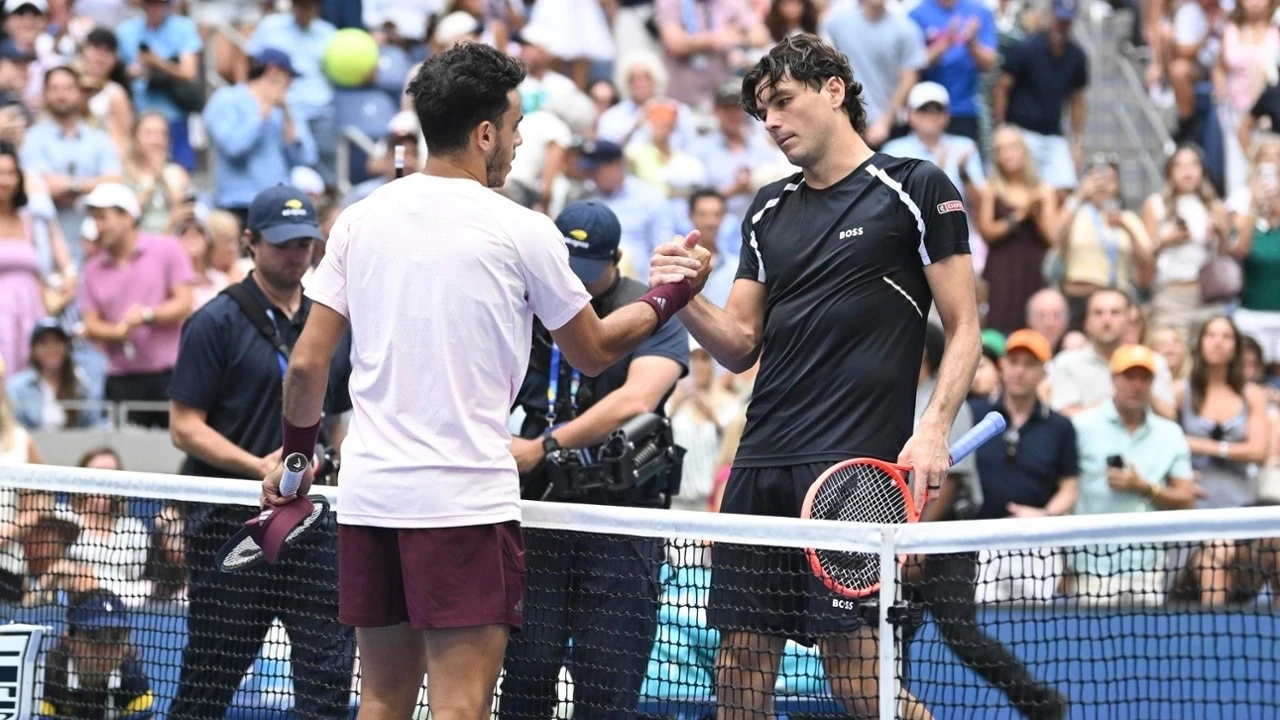
Francisco Cerundolo defeated Taylor Fritz 3-6, 4-6, 6-3, 6-4, 6-4 after changing a match that had been controlled by the American for two sets. Cerundolo recovered from an early deficit in the third, carried the new rhythm through the fourth and saved three consecutive break points at 3-4 in the deciding set. He reached the fourth round in New York for the first time.
Fritz controlled the first two sets with first-strike tennis
Fritz began by taking time away from Cerundolo. A strong serve and a direct forehand let the American decide many exchanges before the Argentine could establish his preferred rhythm. Even when Cerundolo worked through a long service game and created chances, Fritz answered quickly. The opening score reflected that control. Cerundolo was not losing one isolated pattern; he was being asked to defend too often from positions where his next shot could not change direction.
The third set began with a smaller tactical correction
Cerundolo did not need to hit every ball harder. He began to find more reliable depth and used the forehand to move Fritz before attacking the open court. The adjustment reduced the number of short balls that allowed Fritz to step forward. Once the Argentine recovered the early break, the match stopped feeling like a continuation of the first two sets. He could build points in stages and make the American strike an extra ball from a less comfortable position.
| Stage | US Open third round |
|---|---|
| Winner | Francisco Cerundolo |
| Opponent | Taylor Fritz |
| Result | 3-6, 4-6, 6-3, 6-4, 6-4 |
| Key escape | Three break points saved at 3-4 in the final set |
| Next round | Cerundolo faces Alexander Blockx |
A controlled fourth set made the comeback real
Winning the third set created hope, but the fourth required the same decisions without the surprise of a sudden change. Cerundolo continued to serve with enough accuracy to begin points on neutral terms. His forehand then became a way to open space rather than a desperate finish. The decisive break came from pressure accumulated across several exchanges. Reaching a final set after exactly three hours showed that the recovery had become a stable pattern, not one short burst.
The most important hold came under maximum pressure
At 3-4 in the deciding set, Fritz reached 0-40 on Cerundolo’s serve. Losing that game would have left the American serving for the match. Cerundolo instead won five points in succession. The escape mattered for more than the scoreboard: it forced Fritz to process a missed opportunity and gave the Argentine the confidence to attack the next return game. Cerundolo stayed with his plan rather than trying three low-percentage winners simply because the score was dangerous.
Fritz’s level did not collapse everywhere
A comeback from two sets down can be described too easily as one player suddenly failing. Fritz still produced aggressive tennis and created the late opening that nearly decided the fifth set. The change was that Cerundolo absorbed the first strike more often and made the American finish from an extra position. Small errors became more costly because the Argentine was no longer giving away quick points. The match turned through a contest between two active plans, not through one unexplained disappearance.
Cerundolo managed a second long match in three days
The Argentine had already played five sets against Jan-Lennard Struff in the previous round. Repeating that distance raises questions about recovery, but it also gave him evidence that his concentration could survive a long New York match. During the Fritz comeback, he avoided spending energy on the lost opening sets and focused on the next service pattern. Physical resilience mattered, yet the clearer shot selection prevented every rally from becoming a test of endurance.
The result extends Argentina’s presence in the draw
Cerundolo joined Tomas Martin Etcheverry in the last 16. They became the first Argentine pair to reach that stage at the same US Open since Juan Martin del Potro and Diego Schwartzman in 2017. The historical note is useful because it describes the wider result without changing what happened on court. Cerundolo still has a separate next problem against Blockx, whose power and serve create a different match from Fritz’s familiar baseline pressure.
The comeback can be summarized without repeating every number
The final score belongs in the lead and table. The story after that is the change in depth, a steadier forehand pattern, the fourth-set confirmation and the late escape from three break points. Repeating five set scores in every section would hide those decisions. Cerundolo reached the second week because he solved the match gradually and remained composed when Fritz came closest to restoring control.
Recovery now becomes part of the next-round plan
Cerundolo has shown that he can solve a long match, but the next opponent should not receive the same two-set advantage. His staff can preserve the deeper return position and patient forehand construction that changed this contest from the third set. They must also review the early short balls that allowed Fritz to attack. The comeback is most valuable when it improves the opening plan rather than becoming a reason to expect another escape.


