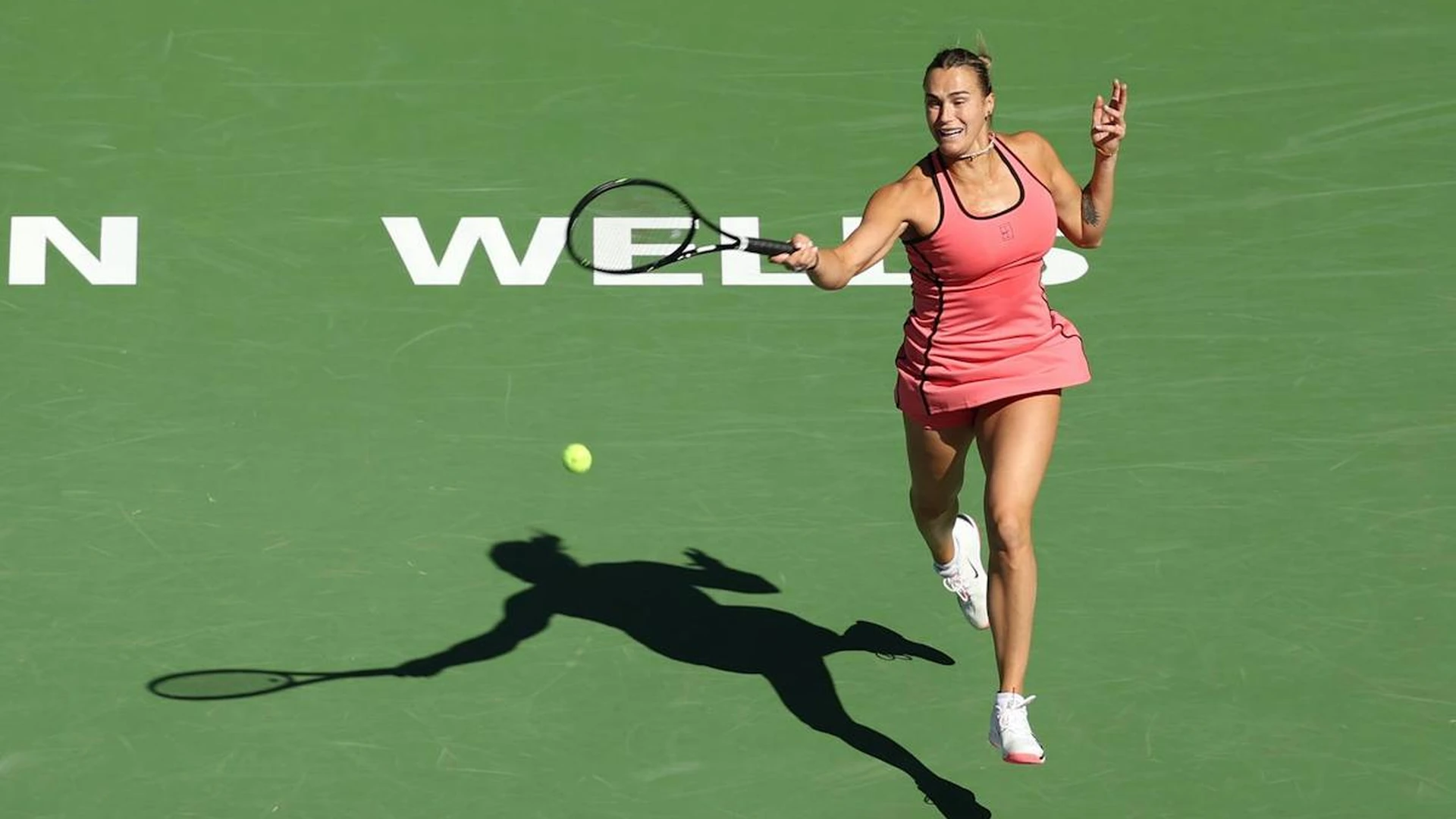
Aryna Sabalenka has qualified for the WTA Finals at Indian Wells for a sixth consecutive season, joining world No. 1 Elena Rybakina in the singles field. Her place was earned through a season with five finals, three titles and deep runs at three Grand Slams. The qualification rewards consistency across surfaces, but it also gives Sabalenka another chance to resolve unfinished business at an event where she has twice reached the title match without winning the trophy.
Five finals built a margin that one tournament could not erase
Sabalenka’s 2026 campaign has included titles in Brisbane, Indian Wells and Miami. Winning consecutive WTA 1000 events in California and Florida created a major block of race points, while reaching five finals showed that the level was not limited to one short peak. That matters in qualification because the season-ending field is shaped by accumulated performance rather than a late invitation based on reputation.
The route also reduces pressure during the final stretch of the regular season. Sabalenka can still chase ranking points and trophies, but she no longer needs to calculate every result against the qualification cut. Training and scheduling can focus on arriving healthy at Indian Wells, with enough competitive matches to stay sharp and enough recovery to avoid carrying fatigue into the round-robin stage.
The Grand Slam results supplied points without a title
Sabalenka reached the Australian Open and US Open finals and the Roland Garros quarter-finals. Those results did not produce a major trophy, yet they show that her baseline held through different conditions and the pressure of long draws. Qualification races reward that repeatability. A player who reaches the closing rounds several times can build a stronger season than one who wins a single large event and exits early elsewhere.
There is also a useful competitive lesson in those defeats. Sabalenka arrives at the Finals with recent evidence of what worked through six matches and what failed against the final opponent. The task is not to rebuild her game. It is to identify the few patterns that became less reliable under the greatest pressure, then protect the serve and first attacking ball that carried her through the earlier rounds.
| 2026 qualification marker | Sabalenka’s record |
|---|---|
| WTA Finals streak | Six consecutive appearances |
| Season finals | Five |
| Season titles | Brisbane, Indian Wells and Miami |
| Grand Slam highlights | Finals at Australian Open and US Open; Roland Garros quarter-final |
| Already qualified | Elena Rybakina and Aryna Sabalenka |
Six straight appearances place her in rare company
The 2026 event will be Sabalenka’s sixth consecutive WTA Finals. Since 2003, Agnieszka Radwanska is the only other singles player to have produced a run of six straight appearances, from 2011 through 2016. Longevity at this level requires more than one dominant season: the player must remain healthy enough to compete, adaptable enough to win on different surfaces and consistent enough to collect points throughout the calendar.
The comparison should not turn the event into a ceremonial reward. Consecutive qualification is evidence of a high floor, but the Finals judge the level available in one concentrated week. Sabalenka’s opponents will all have survived the same season-long filter. Her experience can help with preparation and recovery, yet every group match begins without the protection of her accumulated race total.
The round-robin format changes the response to defeat
Unlike a standard knockout tournament, the WTA Finals allow a player to lose a group match and still advance. That makes scoreline management and emotional recovery especially important. A poor set cannot simply be dismissed once the match is gone because games and sets may separate players with the same win-loss record. Sabalenka needs to keep competing for every return game even when an opponent controls the day.
Her aggressive style can be well suited to that structure if risk is managed. The objective after a difficult start is not to abandon first-strike tennis but to choose safer targets until timing returns. A controlled loss is not the goal, yet preventing one bad passage from becoming a lopsided score can preserve a path to the semi-finals. Experience from five previous editions should make those calculations more familiar.
Indian Wells is a familiar setting with a different competitive rhythm
Sabalenka already won the regular-season Indian Wells title in 2026, so the court environment and desert conditions carry positive evidence. The Finals will not reproduce that tournament exactly. The field is smaller, the schedule is compressed and there is no early round in which to build confidence against a lower-ranked opponent. Every match begins at the level normally associated with the second week of a major event.
That places greater value on the first practice sessions and the serve. Holding efficiently protects energy and keeps opponents from settling into repeated looks at second deliveries. Sabalenka does not need to hit a winner from every neutral ball. If she earns short replies through depth and pace, the decisive attack can arrive one shot later without giving away the initiative.