
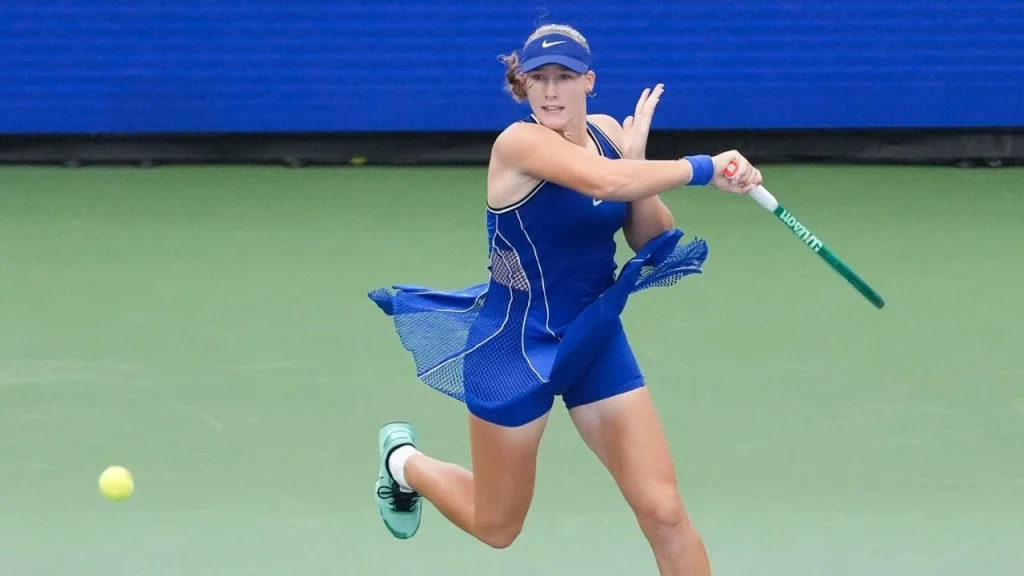
Mirra Andreeva defeated Janice Tjen 6-2, 6-2 in the first round of the US Open. The match became one-sided after a competitive opening, when Andreeva won seventeen points in succession. She used depth, early preparation and calm choices to stop Tjen from restarting attacks.
The first games required adjustment rather than force
Tjen arrived with confidence and tried to take time away from Andreeva. The early rallies showed why the match could not be solved by simply hitting harder. Andreeva improved the depth of her first neutral ball and stopped leaving short replies in the centre. Once Tjen had to strike from farther behind the baseline, the court opened for the next controlled change of direction.
Seventeen consecutive points came from repeated good positions
A long unanswered run can look like sudden inspiration, but the sequence was built through the same reliable advantages. Andreeva returned with depth, recovered toward the centre and made Tjen play one extra ball before changing direction. The run included different types of points, yet the common factor was balance. She rarely needed an extreme shot because the previous ball had already moved the opponent away from a comfortable position.
| Match detail | Confirmed result |
|---|---|
| Round | US Open first round |
| Winner | Mirra Andreeva |
| Opponent | Janice Tjen |
| Score | 6-2, 6-2 |
Tjen’s best route was to interrupt the rhythm early
When Tjen stepped forward and redirected the ball before Andreeva settled, she created pressure. The problem was repeating that action once the Russian’s returns became deeper. A player facing a long run must first stop the next point from following the same pattern. A higher ball, a body serve or a slower exchange can break timing even when it does not produce an immediate winner.
Andreeva kept the second set connected to the same plan
After winning the first set, she did not search for a more spectacular version of her tennis. She continued to protect the middle, choose clear targets and make Tjen hit from difficult contact points. That continuity is a sign of control. Many short matches become complicated when the leader tries to finish every rally too early. Andreeva allowed the advantage to remain useful until the final game.

The figures support the story without taking it over
The final score and the seventeen-point sequence explain the shape of the match. Additional totals are not needed in every section. The main sporting fact is that Andreeva changed the quality of the neutral rally and prevented Tjen from rebuilding momentum. Keeping the numerical detail limited makes the tactical change easier to see and avoids the dense presentation that weakened earlier Tennis Georgia drafts.
A quick result still contains information for later rounds
Andreeva faced an opponent who wanted early contact and had to stabilise the match before she could pull away. That experience may be useful against players who attack second serves or redirect pace. The next opponent will create a different problem, so the winning sequence should not become a rigid formula. Its value lies in the underlying habits: depth, recovery and patient selection.
The first-round result gives Andreeva a completed starting point
Andreeva won the match in straight sets after the seventeen-point run separated the players. The victory moves her into the next round but does not promise a later title or an equally comfortable score. A new opponent will create different serving and movement problems. What is already settled is the opening result: Andreeva absorbed Tjen’s early pressure, took control of the centre and closed both sets.
The return position supported the unanswered sequence
Andreeva’s run became easier when the first return landed deep enough to stop Tjen stepping forward. A return does not need to be a winner to control the point. It can remove the server’s preferred first pattern and create a neutral rally. By repeating that depth, Andreeva turned pressure into a stable position and made each following choice less complicated.
The completed match gives the next opponent useful video
Later opponents can study how Andreeva controlled the centre, but they cannot simply copy Tjen’s opening plan. They must adapt it to their own serve and movement. Andreeva will also review the match and expect a different response, which is why one dominant sequence is evidence rather than a permanent guarantee.


