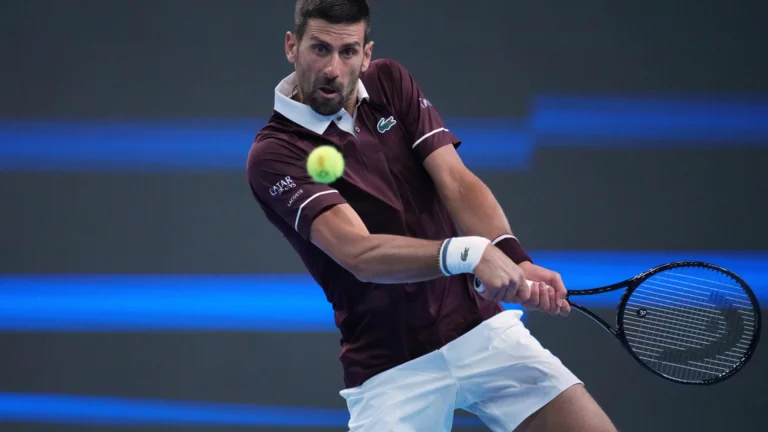
Elise Mertens beat Iga Swiatek 7-6(0), 6-3 in the China Open women’s singles main-draw quarterfinal on hard courts in Beijing on Friday, October 9, 2026. The Belgian advanced to a semifinal against Zheng Qinwen after a match lasting one hour and 50 minutes.
It was Mertens’ first victory over Swiatek in three WTA Tour meetings and her first China Open singles semifinal. She also reached her third WTA 1000 singles semifinal overall, ending a wait stretching back to Dubai in 2021.
The WTA’s match report describes an opening set without a break of serve. Mertens had two break-point opportunities but could not convert either, leaving the tiebreak to separate the players. There, she won all seven points to take the set.
The decisive service break came in the second set, giving Mertens a 3-1 lead. She followed it with a hold without conceding a point to move ahead 4-1. Serving in the final game, she fell behind 0-30 before taking four successive points to finish the match.
Those moments explain the score without suggesting that every game was one-sided. Analysis: a perfect tiebreak can decide a set in which neither player loses serve, while a single break can settle the next if the player holding that advantage continues to protect her own service games.
Mertens did exactly that. Tennis.com’s match card records 11 service games won from 11 played and one break converted from four opportunities. The WTA report also credits her with 24 winners against 11 unforced errors.
What do the serving numbers actually show?
The useful comparison is between how often each player landed a first serve and how often she won the point after doing so. Those measures favoured different players, rather than telling one simple story about serving superiority.
Tennis.com lists Mertens’ first-serve percentage at 60%, with 38 first serves landing from 63 attempts. Swiatek’s figure was 80%, or 59 from 74. Using the displayed percentages, that is a 20-percentage-point advantage to Swiatek in first-serve frequency.
But Mertens won 87% of her first-serve points, taking 33 of 38, compared with Swiatek’s 63%, or 37 of 59. The rounded gap in that category is 24 percentage points in Mertens’ favour.
Analysis: Mertens obtained the stronger return from the first serves she landed, despite putting fewer first serves in. That comparison helps explain her unbroken service record; it does not establish a particular stroke, placement or tactical cause.
The match card’s “0/0 break points saved” entry also needs careful reading. It means Mertens faced no break points, not that she repeatedly escaped them. Swiatek’s 0-30 lead in the closing game therefore never became a break-point opportunity.
Mertens’ Beijing route and semifinal context
The official draw shows two three-set victories before consecutive straight-set wins over Gauff and Swiatek. The table below covers singles only; Mertens’ doubles campaign is separate.

| Round | Opponent | Mertens’ winning score |
|---|---|---|
| Second round | Katie Volynets | 6-0, 4-6, 7-5 |
| Third round | Jelena Ostapenko | 6-2, 3-6, 6-3 |
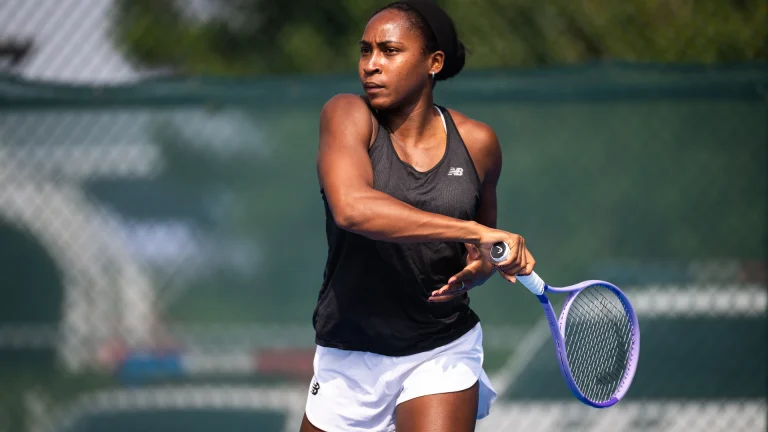
| Round of 16 | Coco Gauff | 6-3, 6-3 |
| Quarterfinal | Iga Swiatek | 7-6(0), 6-3 |
Ostapenko, Gauff and Swiatek made it three consecutive victories over Grand Slam champions. According to the WTA report, this is the first time Mertens has beaten three major champions at one WTA event.
Analysis: the progression from two deciding sets to two straight-set wins is a useful description of her route, but not proof that each performance was better than the last. Opponents and match circumstances differ; the results establish how she advanced, not a universal measure of form.
The quarterfinal victory set up a singles semifinal against Zheng on Saturday, October 10. At the end of Friday’s play, both the official preview and draw identified Zheng as Mertens’ next opponent.
Zheng leads their head-to-head 1-0 after winning a three-set match in Charleston in 2025. Analysis: one previous result offers context, but is a limited basis for forecasting this semifinal.
Mertens also reached the doubles semifinals alongside Diana Shnaider, a separate achievement from the singles run detailed above. The immediate singles consequence of Friday’s win was a place in Beijing’s last four after four main-draw victories, with her service record against Swiatek supplying the clearest explanation of how she earned it.